Chapter 2 Candidate guidance
Introduction#
The FRCS (Tr & Orth) structured oral viva is a daunting prospect because of its high-stakes nature and the uncertainty surrounding it. The aim of this chapter is to consolidate insights from successful former candidates as well as the perspective of a senior examiner to guide you through the difficult challenges and achieve exam success!
The structured, standardized oral exam#
The FRCS (Tr & Orth) represents the standard of knowledge and aptitude required for clinical practice by a day one consultant in the generality of Trauma and Orthopaedics. Passing the exam is an important milestone which symbolizes the pinnacle of a stressful period of intensive study. It is also seen as an opportunity to demonstrate the learning and knowledge you have accumulated overmany years of training!
Achievement of the FRCS (Tr & Orth) enables the erstwhile candidate to apply for his or her
Certificate of Completion of Training and therefore a consultant postIn turn, it leads to largely unsupervised surgical practice.
The examiners expect a competent candidate to have a broad knowledge, possess sound basic principles and demonstrate the requisite key skills and atitudes in their judgement and professionalism.
In effect, they are someone with whom they could entrust the treatment of a family member, or work with as a fellow colleague.
In contrast to examiners in other postgraduate objective structured clinical examinations (OSCEs), in the FRCS (Tr & Orth) oral viva examiners are not forced to recite verbatim a prescriptive text. As detailed in David Limb’s account, they follow a predetermined mark scheme ensuring reproducibility and fairness.
However, to make certain each candidate can achieve their highest possible score, by the process of exploring the limits of their knowledge, this culminates in the experience of a particular viva station being unique to that individual. For instance, despite being asked the same initial starter question from an image as a prompt, the ensuing discussion depends upon whether a candidate correctly identifies the problem from the information, or picks up on hints if they start to veer off topic. Candidates who are well rehearsed at answering problems in clinical scenarios will score highly, compared to those who are unable to apply their knowledge to hypothetical dilemmas, which the examiners believe you should be able to manage competently as a day one consultant in practice.
Viva preparation#
1. Aptitude and mind set
During the exam, your knowledge aptitude only becomes evident to the examiners when you demonstrate it talking around a subject in a competent fashion. Crucially, you must be prepared to do this for all of the important topics on the curriculum. For most candidates, this means a broad rather than narrow knowledge base will allow them to deliver an answer that displays higher-order thinking.
It is important to focus your preparation on the high-yield topics during viva practice, so that you stand the best chance of maximizing your score. For each viva station, you will often be tested on topics from the curriculum encountered in daily practice that are critical to manage correctly for patient safety.
You should be able to generate a list of topics that are recurrently asked every year based on: those that you have already been quizzed on in deanery and departmental teaching; questions from good viva revision textbooks; as well as a list from any past candidate or consultant with FRCS (Tr & Orth)
accreditation.
For instance, in the trauma viva, you must be conversant on all of the topics discussed in a departmental trauma meeting from the management of elbow Terrible Triad to the classification of acetabular fractures. The examiners will expect a comprehensive knowledge because turning up to be quizzed in the morning trauma meeting should have been part of your normal day job for the last five years. In the basic science viva, surgical approaches are often asked after being shown a photograph of an anatomical prosection. Being able to draw a brief line diagram and confidently talk about the important biomechanical principles involved is routinely expected for high-ranking topics such as articular cartilage or the stress–strain curve. To ensure your answer is fluent and that the diagram contains all of the essential features means repeated practice.
2. Speech and communication in the viv a
It is important to realize before commencing preparation for the vivas that when it comes to answering questions universally without exception a t the start, every single candidate due to sit the exam has a poor technique. Much hard work is needed in rehearsing for the viva beforehand to stand a chance of success.
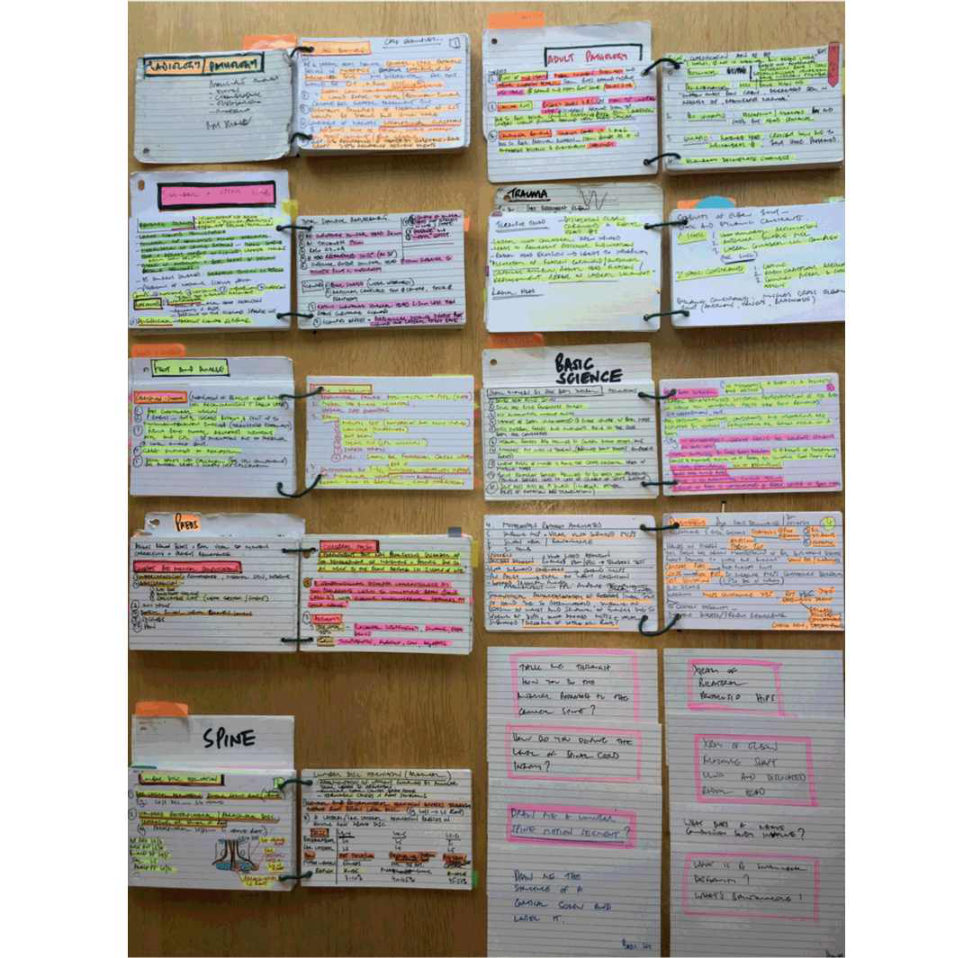
Preparation for the viva is an individual process, but it bears many similarities to how you might go about rehearsing to give a vast number of podium presentations scheduled at a scientific conference for the same day with the added feature that you will be doing it without the use of notes. Part of that preparation would involve several months memorizing everyday the content of what you will say. It would also be imperative to prepare answers on areas that are likely to invite interested questions. If some of the audience appeared hostile or indifferent this would not affect your performance, because you know the material well and can talk about it confidently. Many candidates find the use of index or flash cards an invaluable memory aid during this process (Figure 2.1a,b). Alternatively recording your speech onto a Dictaphone and playing this back can be a powerful revision tool, especially when commuting to work.
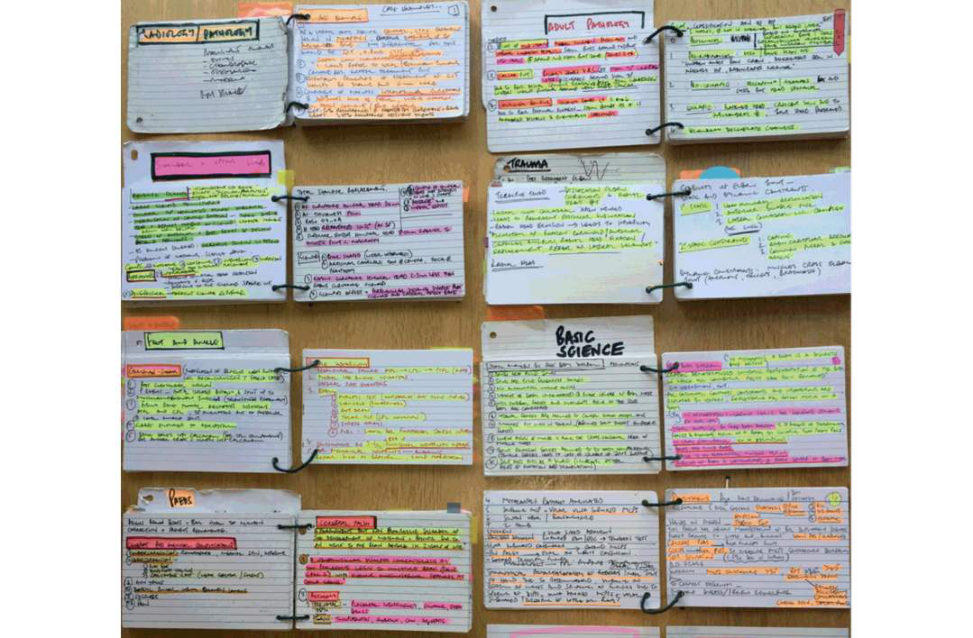
Figure 2.1a,b Revision cards.
For many candidates, it is essential to work on your public speaking so that on the spot, you sound credible to a consultant to whom you have just been formally introduced. Even the late Alan Apley, of
Apley’s System of Orthopaedics and Fractures,1 painstakingly memorised ‘off-the-cuff’ comments and repartee, so that he delivered a polished performance during a presentation. According to the JCIE marking descriptors, to achieve a level 7 or 8 answer you should be fluent and confident without prompting.
Before the start of the viva, while in the holding bay of the exam hall, the myriad candidates flicking through reams of notes in their bags is a testament to how desperate a situation the majority of people find themselves in! Unfortunately, it is extremely difficult underpressure to be able to read something, internalize it and then speak it aloud minutes later in a flawless performance. That is why it is so important to rehearse the answers. For some, this even extends to rehearsing the phrases or ‘discourse markers’ that occur during your conversation:
‘I would want to discuss with a consultant who specialises in ... but essentially , the treatment principles are ...’
‘My primary concern is that I’d want to establish this was in fact a closed, isolated injury. What is the state of the soft tissue envelope ... Whilst a cast is an option the reis a likelihood it will displace, and managing late displacement is a difficult situation. ’
‘I’m really sorry. I’ve made a mistake. I’ve started on completely the wrong track. Can I please start again?’
‘Excuse me. I’m very sorry it’s quite noisy. Can I please clarify what you’ve asked?’
Remember that constantly asking for clarification every time you are asked a question quickly becomes irksome, but you are allowed to do this once or twice because it gets noisy in the exam hall. Typically, there is a key point your answer needs to cover so that you initially demonstrate competence. Thereafter, once you’ve surpassed this and your answer takes off, you can achieve the atiribut es of a fluent and confident higher-level answer. Bear in mind that anything you say to the examiner often becomes the basis of their next question in a predictable sequence. For example, in the following scenario on paediatric septic hip the f ollow-on questions would be anticipated:
From the clinical picture of febrile, non-weight-bearing, raised CR Pand white cell count, I would get an ultrasound to look for an effusion. The child meets Kocher’s criteria ...
What are Kocher’s criteria?
Kocher’s paper published in 1999 is almost 20 years old. It was a retrospective multivariate analysis differentiating septic arthritis from an irritable hip in children.2 It has been superseded by other studies but is still relevant to practice, apart from one criterion being an elevated ESR which in some hospitals is difficult to obtain out-of-hours nowadays. With 4 out of 4 criteria, there was a 99% probability predictive for septic arthritis.
The scan shows an effusion.
I would take him to theatre to wash him out via an anterior approach.
What is the anterior approach?
Supine, sandbag, bikini incision. Interval between sartorius and TFL, gluteus medius and rectus femoris. The internervous plane is superior gluteal and femoral nerves. It isn’t necessary to go up proximally over the iliac crest or split the apophysis. The structure at risk is the lateral cutaneous nerve. I would want to visualize the articular cartilage of the femoral head to confirm I’m in the joint. To do this, some people excise a small square of capsule by a cruciform incision ... If you struggle answering questions aloud, rehearsing the commonly asked topics in your study group pays dividends. As you become more familiar with the viva process you can then predict the ensuing questions the examiner moves on to for each topic.
3. Study group practice
The merits of a study group cannot be overstated. It is a major leap from reading material to articulating a viva answer. Meeting regularly to discuss your answers will improve the quality of what you say, as well as highlighting areas where your deficiencies lie. Often each member of the group has a particular subspecialist interest that they want to pursue as a long-term career. In this way you are able to complement each other and fill outstanding gaps in knowledge. By far this represents the most efficient use of your time in the final months; and will yield the greatest improvement.
It is important that in your viva study group you pool resources and help each other. Remember that every deanery has a set of consultants who are fully expecting you to approach them for viva practice.
Typically, they will be FRCS examiners already, or have a role in the deanery mock exam or viva courses.
Often they have a FRCS viva PowerPoint presentation on their laptop. To make it the most efficient use of time, you should attend these as a group. These sessions are absolutely invaluable because they often recreate what you will be asked. You have the opportunity to see how other people answer questions that you will be asked in the real thing. For instance, if you come across an exceptional answer which you think is close to perfect, it is self-evident you should make a note, write it out later and practise it, so that it becomes commift ed to memory. Should you be asked the same question in the viva, you can recite a brilliant answer and almost certainly score 7–8. First impressions make a significant contribution in a time-pressured environment. If you are in the fortunate position of being able to do this on the first question, you have a high chance of passing that station because the other examiner will also be silently impressed with the level of knowledge you demonstrate on the starting question.
Skyping and FaceTime can be useful if there are difficulties arranging a regular meeting due to on call commitments or long distances that have to be travelled. However, there is no substitute to the actual experience of being quizzed face-to-face with a consultant or post-FRCS trainee acting as an examiner critiquing your answer. There are many subtle nuances and non-verbal communication skills you will acquire; and any irritating mannerisms which you weren’t consciously aware of doing will be highlighted to you.
4. Assigned educational supervisor practice
It is important in the run-up to the exam that you let all of the trainers know in your unit that you have the Part 2 coming up, and you need help! There are many reasons for this, not least the fact if you have any non-essential clinical commitments these can be temporarily dropped. For instance, if any spare time arises in your timetable, they know you have to focus on viva and clinical revision. Now is the time to be forthright and tell them where your deficiencies lie. If you have not done a paediatric placement, and need to go to elective paediatric clinic, they need to be told! There is absolutely no way you can pass the exam without attending these clinics. Similarly, if your placement in hand surgery was lacking, you need to make amends for this.
Your educational supervisor and the other consultants you work with can play a vital role in the last few months. Every time you do a fracture clinic, or for that matter any other clinic, ask them to go through an FRCS case or ‘watch you examine apa tien t with pathology’.
The number of vivas that have a plain radiograph as the starting point is ridiculously commonplace.
How to deal with a peri-prosthetic fracture in apa tien t with loosening, for instance, or a complex primary hip in apa tien t with protrusio or ankylosing spondylitis, are everyday topics that you see in clinic, and likewise will be almost certain to get in the viva. These will be prefaced by ‘Have a look at this iPad, and tell me what you think’ in the viva. In effect, this is the same as being sat in the clinic in between patients, with your trainer saying ‘Have a look at this X-ray on PACS and tell me what you think.’
5. FRCS viva courses
It is not essential to have done a course to do well in the viva. However, an FRCS viva or clinical revision course can be a saving grace if you know that your technique is lacking and you have deficiencies. For example, to cover the entire basic science syllabus for the viva is a substantial amount of work and going on a good course that covers basic science will save you considerable time, as it recaps the numerous weighty topics such as: stress–strain, free body diagrams, viscoelastic material properties, types of lever, nerve action potential and numerous others that sequester hours of revision. If you go with members of your group, you can spend the evenings practising in your hotel room, which again is quality revision time.
It is true that there is some variability in the quality of the teaching on courses. As a rule, you are bound to gainsome helpful information and knowledge, and there will likely be negative and positives aspects for each course that you go on. If you strongly believe your time and money were wasted, then you are entitled to let the organizers know. It would be worth bearing in mind, however, that almost all courses are run by practising consultants who have to make time to organize them for litile or no recompense; and if they stopped doing it altogether most candidates would be the worse off. Also, most reputable courses will have a current or previous FRCS examiner in the faculty, although this may not be openly advertised, who will provide valuable insights.
General approach and what to do when things go wrong#
The format for oral viva questions is detailed in David Limb’s account. Vivas are structured so that the examiners have preset questions, with which they start an exchange and then quiz the candidate as things progress beyond initial competence to the discussion stages involving higher-order thinking. Oral exam questions are prepared so as to be crystal clear and explicit, with default competence questions if candidates are unable to discuss the more challenging topic areas in the syllabus.
At some point, most candidates require help from the examiner. Now and again, most people will experience some prompting if they stray off topic. The examiner’s answer sheet contains a list of prompts to guide the candidate back to the subject. It is the responsibility of the examiners to ensure that the requisite points are covered, and the answer sheets contain more information than all but the highest-flying candidates will be expected to cover.
Occasionally you may experience the unpleasant sensation of becoming completely unstuck. This is often because you have inadvertently missed the point of the original question from the outset. This is why it is so important to listen extremely carefully to every word the examiner says, as this will contain all of the clues you need to arrive at the correct answer. While sometimes it appears examiners may ask something in an innocuous fashion, it is absolutely imperative that you have listened to every single word and think carefully before launching into an answer. It is also important to have some means to compensate for a bad score by being strong elsewhere in a particular viva subject.
Likewise, examiners expect that if a candidate knows a topic well, unprompted they will start confidently reciting vast amounts of knowledge to score highly. This can be done if you have practised your answers well and rehearsed what the likely questions are. This form of prolific data dump is often rewarded with the examiner siting back in their chair, and then interrupting only to change to start a new topic after 5 minutes. In this situation it can sometimes be observed the examiner will subtly nod as you deliver a well-prepared answer, which indicates they agree with what you are saying. Examiners are highly trained so that they are not supposed to reveal any conscious encouragement, but during the course of a long day they can sometimes f ail to maintain a deadpan face all the time.
Formulating answers to oral questions
Before you answer the question, take a few seconds to mentally construct a checklist of the main points you want to make and then start calmly with your answer. This avoids blurting out the first thing that comes into your head and gives the examiners the impression you are giving a logical, considered response.
If you are confident on a topic keep talking, keep to the question that was asked, and go for it! Avoid going off on a tangent as you don’t score points for this. If you can direct the answer onto a topic you know well this can be a rewarding position to be in. Once you have finished your answer stop, smile at the examiners and calmly wait for the next question. Avoid the temptation to fill the silence by adding superfluous information to the end of your answer, as this falsely gives an impression that you are waffling. This annoys the examiners because you don’t appear to be giving a straighfoorward answer to a direct question. It can also bring you into an area you really didn’t want to talk about. The examiners may cut you off mid-sentence, it can happen whether you are doing well or not so don’t let this put you off.
Just concentrate on the next question.
If the examiner asks you if you are sure about your answer this generally means you have answered incorrectly, so unless you are very self-assured, take the hint. If the examiner asks you to clarify an answer, they are usually checking to make sure they actually heard what they thought they heard, which again is usually the wrong answer!
It is better not to argue with the examiners if they point out your answer is wrong, even if deep down you are convinced it reflects the latest evidence or opinion. You may get the sense the examiner is unhappy because your answer does not match what is wrift en on their sheet, so it is reasonable to explain your justification. Although to defuse some of the tension in this situation you can preface this with ‘In my humble opinion’, or ‘there is some controversy in this area, and I’m aware of this evidence’. Remember, part of what you are being tested on in the viva is your professionalism and atitude. Being a consultant involves skills in navigating through controversial areas. Offer your considered reasoning of the issue without being patronizing.
Quoting the literature#
Being able to discuss the evidence for a particular treatment or justifying how and why you do something is the hallmark of understanding in the exam and a clear sign that you are someone suitable for consultant practice. Likewise, being unprepared to the extent that you don’t have any relevant papers which you can discuss in your knowledge base effectively means you are puting yourself at a serious disadvantage to the other candidates. It is extremely difficult to remember every important paper that exists in every topic.
Realistically, if your time is limited then you will have to be selective about what things you look at and prepare answers for. This means that trawling through every JBJS in the last 12 months is not necessarily a good use of time. However, making an index cardona seminal paper is worthwhile because it means you can quote something when being asked for the evidence. You will not be expected to know the length and breadth of the orthopaedic literature. It is more important to have some appropriate papers to talk about, which either you will have come across from your study group, from a revision course lecture or from listening to your peers being quizzed.
One guide for the important hallmark papers is to look through any FRCS viva revision textbook, this one included, for the references for papers mentioned in the model answers in the endnotes of each chapter. If the same paper is recurrently signposted overmany topics – such as the Lidwell3 paper on the effect of ultraclean air theatres on deep infection in joint replacement, which is a reference for prosthetic joint infection in adult pathology as well as theatre sterility in basic science – this probably means you should be familiar with it. If you are pushed for time then one shortcut is to read the abstracts only, but be warned there is a risk to this! The danger is if you mention a paper the examiner may well ask you the details of that study, so preparing in this fashion is based on whether you feel you can carry it off in the exam underpressure. The National Joint Registry is something you are expected to be able to discuss. One perennial topic is the relative advantages and disadvantages of using registries to guide practice, whether these are regional or national. How survivorship favours more established prostheses or the effect of data collection and the measurement of endpoints are among some of the other discussion points you will come across in your study group.
Final advice#
It rapidly becomes apparent to the examiners how well a candidate has prepared for the structured oral exam. Usually within the first two minutes most candidates will have demonstrated their knowledge and aptitude to indicate what their score should be. Unfortunately, in the unlucky situation that a candidate rapidly draws a blank from the start and cannot progress from the initial competence question this usually spells bad news. However, even if this does happen, all is not lost due to the marking system allowing a second chance by means of compensating for a poor score in another viva station. Grasping that second chance is dependent on being practised sufficiently so that you can perform under the inevitable pressure that you will feel in the next viva station, as well as having an adequate knowledge to raise your score.
This is why if you put in the hard work and preparation early, then you will be able to withstand the setbacks which almost inevitably occur on the day, and come through the viva with a pass!
References
1. Blo mAEd.) Apley and Solomon’s System of Orthopaedics and Trauma, 10th Edition. Boca Raton: CRC
Press; 2017.
2. Kocher MS, Zurakowski D, Kasser JR. Differentiating between septic arthritis and transient synovitis of the hip in children: an evidence-based clinical prediction algorithm. J Bone Joint Surg Am.
1999;81(12):1662–1670.
3. Lidwell OM, Lowbury EJ, Why teW et al. Effect of ultraclean air in operating rooms on deep sepsis in the joint after total hip or knee replacement: a randomized study. Br Med J. 1982;285:10–14.
Section 2